








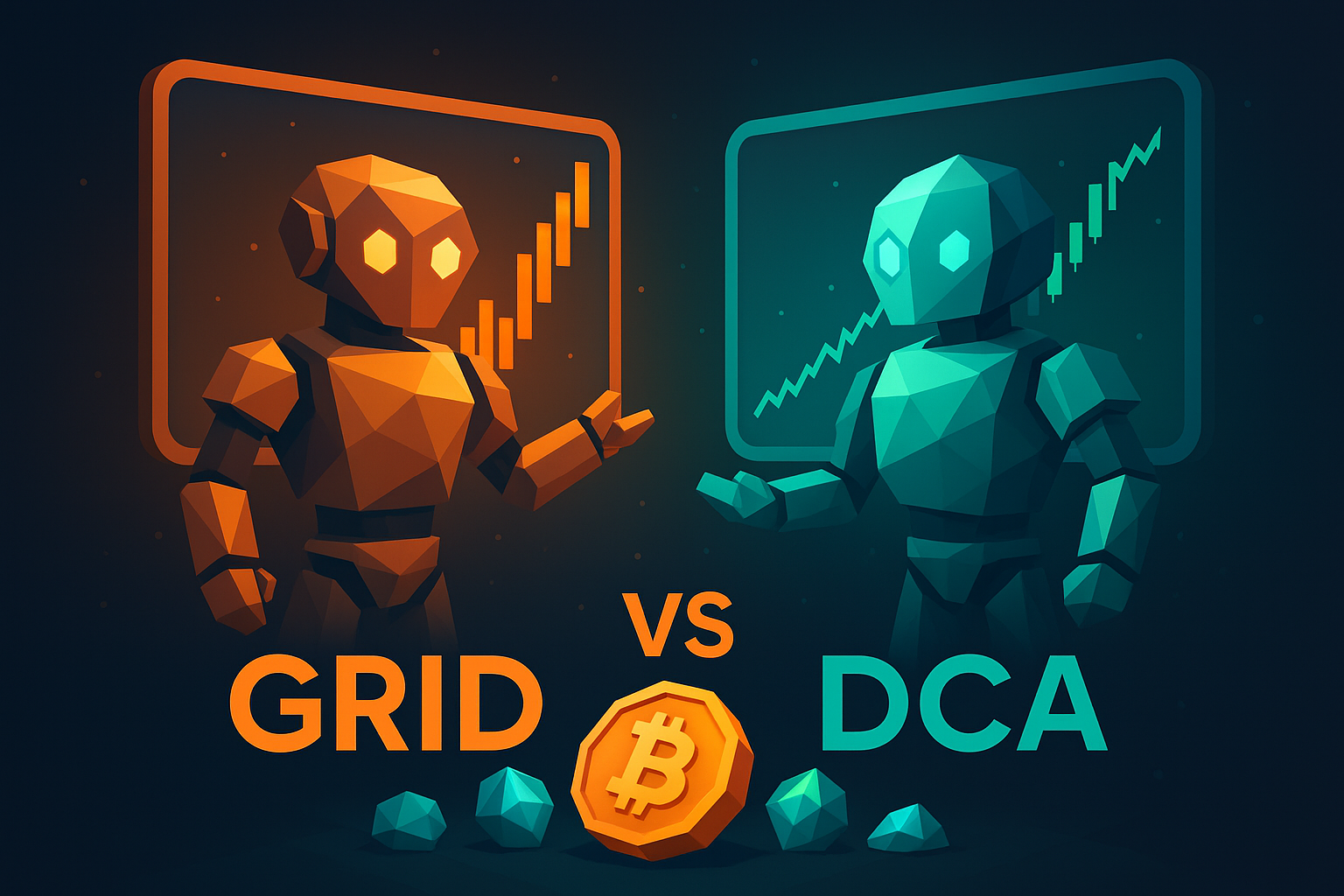
Automated trading bots have become the go-to tool for crypto traders who want to take emotion out of the process and build wealth semi-passively.
If you’re a newer trader scrolling through Twitter or Reddit, you’ve probably seen both:
- Screenshots of grid bot profits
- Threads insisting you should “just DCA and hold”
The confusion is understandable. Both grid bots and DCA bots automate trading — but they are built for different goals and different market conditions.
This article cuts through the hype and gives you a clear, practical comparison so you can decide which bot (or whether both) makes sense for your situation right now.
Key takeaway:
- Grid bots can shine in sideways / ranging markets by harvesting frequent small profits.
- DCA bots are best for long-term believers who want to accumulate assets through trends and cycles.
For most beginners, starting with a simple DCA bot on Bitcoin or Ethereum is lower-risk and lower-stress. Grid bots can be powerful — but they demand more knowledge, calibration, and monitoring.
Disclaimer: This article is for educational purposes only and is not financial advice. Crypto trading is risky. Always do your own research and start small.

Quick Refresher: What Are DCA and Grid Bots?
DCA Bots: Automated Dollar-Cost Averaging
A DCA bot automatically buys a fixed amount of cryptocurrency at regular intervals — for example, $50 of Bitcoin every Sunday — regardless of price.
The strategy comes from traditional investing: instead of trying to time the exact bottom, you spread your buys over time, smoothing out the impact of volatility. The bot takes care of the schedule so you don’t have to remember, and it won’t panic when the market dumps.
Simple example
- Bot setting: Buy $100 of BTC every 7 days for 12 weeks
- Prices over 4 weeks: $30k → $29k → $31k → $32k
You automatically buy more BTC when it dips (at $29k) and less when it’s higher. Over time, your average cost sits somewhere in the middle — without you ever trying to “nail the bottom”.
DCA bots are:
- Simple to understand
- Easy to set up
- Designed for people who believe in an asset long term
Grid Bots: Automated Range Trading
A grid bot places multiple buy and sell orders within a predefined price range (the “grid”). When price bounces up and down inside that range, the bot:
- Buys near the bottom of the range
- Sells near the top of the range
- Repeats this cycle over and over, taking small profits each time
Simple example
- Asset: ETH
- Grid range: $1,900–$2,100
- Number of grid levels: 20
The bot places a ladder of buy orders at lower prices and sell orders at higher prices. As ETH oscillates inside this band, it executes dozens of “buy low, sell high” micro-trades. In a clean range, this can generate steady percentage returns on the allocated capital.
Grid bots are:
- More complex to configure
- Sensitive to range selection
- Built to monetize sideways or choppy markets, not strong trends
How DCA vs Grid Bots Behave in Different Market Regimes
The real test isn’t what a bot promises — it’s how it behaves when the market changes. Let’s look at four common regimes.
1. Sideways / Ranging Markets
Scenario:
Bitcoin trades between $28k and $32k for three months. The chart looks like a flat zigzag: up a bit, down a bit, no clear trend.
How a grid bot behaves
This is where grid bots are in their element.
- Every small bounce up triggers sell orders
- Every small dip down triggers buy orders
- A well-tuned grid might execute dozens of trades per month, each netting a small profit (before fees)
Over a few months, cumulative gains can add up — especially if fees are reasonable and the range holds.
How a DCA bot behaves
A DCA bot just keeps buying on schedule.
- Week 1–12: you buy $100 of BTC every week
- You end up holding more BTC, with an average entry somewhere near the middle of the $28k–$32k range
You’re not explicitly monetizing the small zigzags — you’re quietly building a long-term position.
Takeaway:
In clean, sideways markets, grid bots typically come out ahead on short-term returns. DCA is neutral here: it doesn’t exploit the oscillation, but it builds a base position for when the trend eventually breaks.
2. Strong Uptrend
Scenario:
Price climbs steadily from $30k to $45k over three months with higher highs and higher lows.
How a grid bot behaves
Uptrends expose a key weakness of basic grids:
- As price moves above your upper grid boundary, the bot runs out of sell orders and stops trading
- It may end up holding a chunk of your capital in stablecoins, having sold at lower levels
Result: you captured some small profits in the early part of the move, but you miss a big chunk of the trend. The bot effectively “traded away” the asset before the main rally.
More advanced or AI-assisted grids can shift the range upward, but that adds complexity and still won’t capture all of the move.
How a DCA bot behaves
A DCA bot keeps accumulating into the uptrend:
- Week after week, it buys $100 of BTC at gradually increasing prices
- Your average entry might end up around $37k, while price trades at $45k
You didn’t time the bottom, but your long-term position is strongly in profit.
Takeaway:
In clear uptrends, DCA usually wins for beginners. It compounds your long-term exposure instead of selling into strength.
3. Strong Downtrend / Crypto Winter
Scenario:
Price grinds down from $30k to $15k over three months — lower highs, lower lows, negative sentiment everywhere.
How a grid bot behaves
This can be dangerous if misconfigured.
- As price falls through your grid levels, the bot keeps buying dips
- If the range is too wide or poorly placed, it may deploy most of your capital near the top of the move
- You end up heavily long a falling asset, with large unrealized losses and no dry powder left
You’re at the mercy of a future recovery that may or may not happen.
How a DCA bot behaves
DCA also keeps buying dips, but with a key difference:
- Capital is deployed in fixed chunks over time, not all at once
- After three months, your average entry might be around $22–23k instead of $30k
- You’re still underwater at $15k, but you’ve built a position at a much lower cost than a lump-sum buy
However, if you’re DCAing into a weak or doomed project, DCA just spreads out the loss — it doesn’t prevent it.
Takeaway:
Neither bot “wins” in a strong downtrend. DCA has a slight edge because capital deployment is steadier and more controlled, but the real lesson is: only automate into assets you truly believe in and understand.
4. High-Volatility Chop
Scenario:
Price whips +15%, -12%, +10%, -8% with no clear direction. It’s messy, emotional, and hard to read.
How a grid bot behaves
- If the chop stays largely inside your chosen range, grid bots can perform well
- Lots of up-and-down swings = lots of small “buy low, sell high” cycles
- Large spikes beyond the grid can stall trading or leave positions stuck
Leverage makes this regime even riskier — sudden wicks can nuke over-leveraged grids.
How a DCA bot behaves
- DCA is mostly indifferent to short-term chaos
- It keeps buying on schedule, focusing on the multi-month or multi-year horizon
- Short-term noise becomes irrelevant if your thesis is long term
Takeaway:
In choppy conditions, grid bots have more upside but also more moving parts. DCA stays boring and calm, which is often exactly what a new trader needs.
DCA Bot vs Grid Bot: Head-to-Head Comparison for Beginners
Here’s a side-by-side view of what actually matters for a newer trader:
| Dimension | DCA Bot | Grid Bot |
|---|---|---|
| Ideal Market | Any trend (up, down, sideways), long-term focus | Sideways / range-bound / choppy markets |
| Setup Complexity | Very low – choose pair, amount, frequency | Medium – must choose range, number of grids, spacing, and sometimes advanced options |
| Ongoing Monitoring | Minimal – monthly check is often enough | Moderate – should be checked weekly or during large moves |
| Capital Efficiency | High – most or all capital is working continuously | Medium – part of capital may sit idle when price leaves or hugs one side of the range |
| Risk of Big Drawdown | Moderate – tied to asset performance over long term | Moderate–high – poor range or unexpected breakout can trap capital or create large drawdowns |
| Fee Impact | Low – few trades per month | High – many small trades; fees must be considered carefully |
| Emotional Stress | Low – “boring by design” | Medium – more settings to worry about, more temptation to tweak |
| Best Asset Types | BTC, ETH, and high-conviction large caps | BTC, ETH, and very liquid alts with tight spreads |
| Minimum Useful Capital | Works from very small amounts (e.g., $100+) | Typically needs more (e.g., $200+ or more) to build a meaningful grid |
This is why, in practice, DCA fits most beginners better: it’s simpler, less stressful, and more aligned with long-term wealth building.
What Role Does “AI” Actually Play?
You’ll see plenty of marketing for “AI grid bots” and “AI-powered DCA”. Here’s the straightforward reality:
- AI can tune and adapt parameters (when and how much to buy, how wide a grid should be, when to pause)
- AI does not change the economic nature of either strategy
AI on DCA Bots
An “AI DCA bot” may:
- Increase buy size when sentiment is extremely fearful
- Reduce buys during obvious euphoria
- Slightly adjust timing to avoid obvious short-term spikes
It still behaves like DCA: steady accumulation with some smart tweaks.
AI on Grid Bots
An “AI grid bot” may:
- Automatically choose grid range based on recent volatility
- Adjust spacing when volatility expands or contracts
- Pause or move the grid when a strong trend is detected
It’s still a grid bot: buying low, selling high inside a band. AI just helps it avoid obviously bad conditions.
Bottom line:
AI can make good setups a bit better and bad setups blow up faster. For beginners, it’s smarter to understand basic DCA and basic grids first, then layer AI features on top later.
Matchmaking: Which Bot Fits Which Beginner?
Let’s plug this into real-world personas.
Persona 1: Busy Long-Term Believer
- Profile: Full-time job, believes in BTC/ETH for 3–5+ years, no time or desire to watch charts.
- Goal: Build a long-term position with minimal effort.
Best fit:
- Simple DCA bot on BTC and/or ETH
- Fixed amount per week (e.g., $50–$100)
- Review once a month
No grids, no leverage, no complexity. Let time in the market do the heavy lifting.
Persona 2: Sideways Market Survivor
- Profile: Already holds BTC/ETH, frustrated with months of sideways price action.
- Goal: Earn something from the chop without destroying the core position.
Best fit:
- Keep core holdings untouched
- Run a spot grid bot on BTC or ETH with:
- 10–20% of trading capital
- A range of ~5–8% around current price
- 20–30 grid levels
- No leverage
When the market leaves the range, you reassess and either stop or reposition the grid.
Persona 3: Altcoin Curious Beginner
- Profile: Wants exposure to a few promising altcoins, but knows they’re risky.
- Goal: Learn and experiment without betting the house.
Best fit:
- DCA bot into 2–3 liquid, researched altcoins
- Small allocations (e.g., $20–$50 per coin per week)
- Treat it as “high-risk tuition”, not core retirement money
Avoid thinly traded micro-caps and meme coins for your first DCA experiments.
Persona 4: Tinkerer / Strategy Nerd
- Profile: Enjoys charts, backtests, tweaking parameters, and learning market structure.
- Goal: Combine long-term accumulation with learning to trade ranges.
Best fit (after some experience):
- 60–80% of bot capital in BTC/ETH DCA
- 20–40% in a conservative spot grid during clear ranges
- No leverage until you’ve run successful tests through an entire sideways phase
This gives you a stable base plus a sandbox to experiment with grid logic.
Common Beginner Mistakes (And How to Avoid Them)
DCA Mistakes
1. DCAing into the wrong asset
DCA doesn’t turn a bad project into a good investment.
If the asset dies or trends toward zero, DCA just spreads your losses over time.
Fix: Only DCA into coins you would be comfortable buying in a lump sum today (typically majors or very high-conviction projects).
2. Panic-stopping during a bear market
Many beginners:
- DCA during mild dips
- Panic and stop the bot when the market truly crashes
Ironically, they stop buying where DCA is most powerful.
Fix: Set DCA rules when you’re calm and only use money you won’t need for 2+ years. Commit to staying the course through at least one full cycle.
3. Using short-term money
If you DCA with money needed in 3–6 months (rent, tuition, etc.), you’ll feel forced to sell at terrible moments.
Fix: DCA only with long-term capital you can leave untouched.
Grid Mistakes
1. Running a grid in a strong trend
Launching a grid in the middle of a breakout means:
- You sell early
- Your capital ends up in stablecoins
- You miss the big move
Fix: Avoid grids when the chart looks like a clear staircase (strong trend). They’re built for ranges, not rockets.
2. Using leverage out of the gate
High-leverage grid bots can be liquidation machines. One nasty wick and a “small” loss becomes a full account wipe on that bot.
Fix: Start with spot grids only. If you ever touch leverage later, keep it very low and on a small portion of capital.
3. Grid range too tight or too wide
- Too tight → hundreds of micro-trades, fees eat your profits
- Too wide → barely any trades, lots of idle capital
Fix: For majors like BTC/ETH, many beginners start with a total range around 5–8% and 20–30 grids as a learning baseline, then adjust.
4. Ignoring the bot when price leaves the range
If BTC breaks far above your grid, your bot might simply stop trading while your capital sits idle.
Fix: Set a weekly reminder to review your grids. If price has clearly left the range, decide whether to stop, adjust, or redeploy.
Practical Decision Framework: How to Choose (or Combine Both)
A simple way to decide:
Step 1: Define your main goal
- “I want long-term exposure to BTC/ETH.” → Start with DCA only.
- “I want to monetize sideways volatility.” → Consider grid once you can recognize ranges.
- “I want both.” → Use a hybrid approach (DCA core + small grid overlay).
Step 2: Evaluate your time and attention
- Almost no time → DCA only.
- Can check once a week → DCA + occasional small grids.
- Can check daily and like tinkering → Hybrid, with strict risk limits.
Step 3: Check your drawdown tolerance
- Can’t handle seeing -20% → You may not be ready for any bots; start with education first.
- Can tolerate -20–30% on a portion of capital → DCA is manageable, grid is possible with small allocations.
Three Starter Setups
You can adapt the numbers, but the logic is what matters.
Setup A: Pure DCA (safest, recommended for most)
- 100% bot capital → BTC and/or ETH DCA
- Frequency: 1–2 buys per week
- Time horizon: 2+ years
- Leverage: none
Setup B: DCA + Small Grid Hybrid
- 70–80% bot capital → BTC/ETH DCA
- 20–30% bot capital → Spot grid on BTC or ETH during a clear range
- No leverage, defined range, weekly reviews
Setup C: Grid-Focused (for advanced beginners)
- 100% bot capital → Spot grid on BTC/ETH
- Tight range, many grids, only in confirmed sideways conditions
- No leverage, frequent monitoring
Sanity checks for all setups:
- Don’t put more than 10–20% of your total crypto portfolio into any single bot.
- Avoid leverage on your first bots.
- Start small, review results, then scale slowly.
FAQs: Quick Answers
Q1: Is DCA always safer than grid?
Not always. DCA reduces timing risk but doesn’t protect you from holding a bad asset. Grid can limit exposure to a specific price range but can also get trapped or underperform trends. They have different risk profiles, not “safe vs unsafe”.
Q2: Can I lose money with a DCA bot?
Yes. If the asset performs poorly over time, your position can stay underwater or go to zero. DCA mainly protects you from entry timing regret, not from picking the wrong coin.
Q3: Should beginners use leverage with grid bots?
Strong no. Leverage amplifies every mistake and can lead to full liquidation from normal volatility. Learn spot grids first; many traders never need leverage at all.
Q4: What happens if I stop DCA halfway through a bear market?
You freeze the strategy. Your average price is whatever you’ve accumulated so far, and you miss future lower-price entries. DCA only works as intended if you stay consistent through both good and bad periods.
Q5: Can I run DCA and grid on the same asset?
Yes — if you clearly separate capital and goals. For example: DCA builds a long-term BTC stack, while a small grid trades short-term volatility. Just don’t mix the funds or let one bot interfere with the other.
Conclusion: Two Tools, Two Jobs
Grid bots and DCA bots are fundamentally different tools:
- Grid bots are active range-trading machines, best in sideways or choppy conditions and for traders who are willing to monitor and tune.
- DCA bots are quiet accumulation engines, best for believers in assets like BTC/ETH who want to automate their long-term plan and avoid emotional decisions.
For most beginners, the smartest starting point is:
- Begin with a simple DCA bot on BTC and/or ETH using money you won’t need for years.
- Learn how it feels to go through dips and rallies while staying consistent.
- After a few months, if you’re still curious and comfortable, experiment with a small, conservative grid during a clearly ranging market.
Automation can be powerful, but it’s not magic. Bots amplify your strategy, discipline, and asset choices — they don’t replace them. Start simple, protect your capital, iterate slowly, and let experience be your edge.
Discover more from aiCryptoBrief.Com
Subscribe to get the latest posts sent to your email.




5 Comments
Pingback: 7 AI Trading Bot Mistakes & How to Avoid Them (2025) - aiCryptoBrief.Com
Pingback: How to Backtest and Paper Trade AI Crypto Bots (2025) - aiCryptoBrief.Com
Pingback: AI Crypto Brief – This Week’s Top Narratives, On-Chain Moves and Bot Setups - aiCryptoBrief.Com
Pingback: Weekly Crypto Analysis: BTC & ETH Forecast Nov 2025 Week 3 - aiCryptoBrief.Com
Pingback: AI Trading Bot Glossary: 25 Essential Terms for Safe Bot Trading - aiCryptoBrief.Com